

AI in Textile Market Size to Worth USD 68.44 Billion by 2035
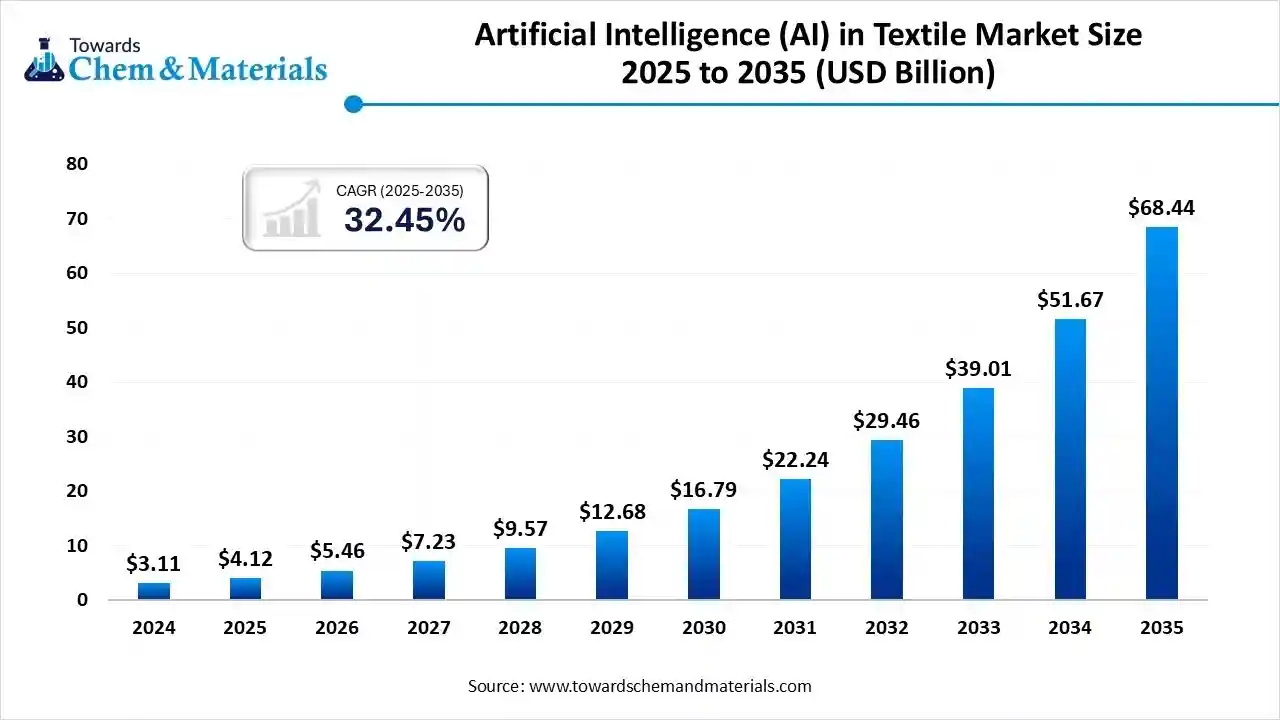
According to Towards Chemical and Materials Consulting, the global AI in textile market is projected to grow from USD 4.12 billion in 2025 to USD 68.44 billion by 2035, growing at a CAGR of 32.45% from 2025 to 2035.
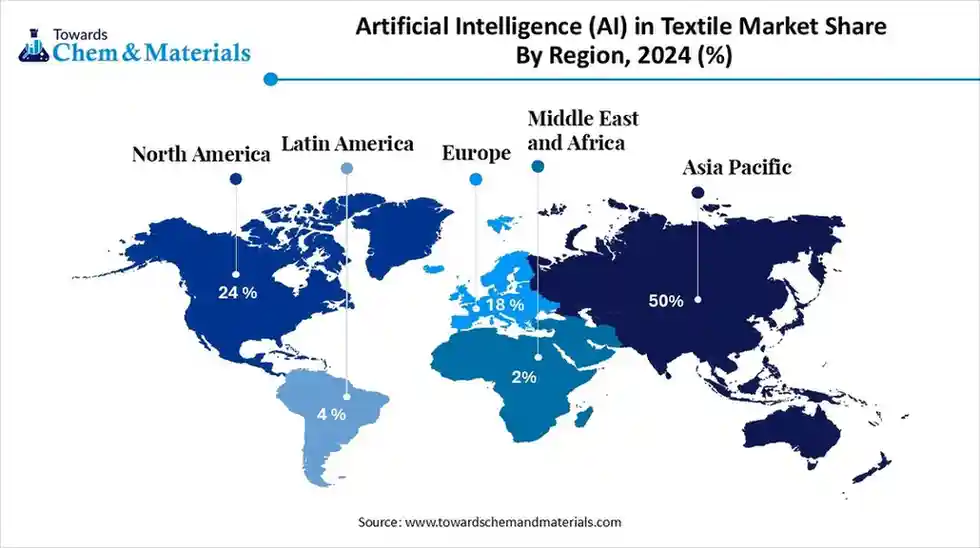
Ottawa, Nov. 19, 2025 (GLOBE NEWSWIRE) -- The global AI in textile market size is calculated at USD 4.12 billion in 2025 and is predicted to increase from USD 5.46 billion in 2026 is expected to be worth around USD 68.44 billion by 2035, growing at a compound annual growth rate (CAGR) of 32.45% over the forecast period 2025 to 2035. The Asia Pacific artificial intelligence (AI) in textile market held the largest share of 50% of the global market in 2024. A study published by Towards Chemical and Materials a sister firm of Precedence Research.
The growth of Artificial Intelligence (AI) in the textile market is primarily driven by rising demand for advanced quality control systems that can detect subtle fabric defects with high precision, along with the need for greater operational efficiency through predictive maintenance and automated process optimization.
Download a Sample Report Here@ https://www.towardschemandmaterials.com/download-sample/6000
What is Meant by Artificial Intelligence (AI) in Textile?
The Artificial Intelligence (AI) in the textile market is rapidly expanding as manufacturers integrate advanced digital technologies to enhance production efficiency and product quality. AI is being used for automated fabric inspection, predictive maintenance, and real-time monitoring, allowing companies to reduce defects and minimize operational downtime. The industry is also leveraging AI-based analytics for demand forecasting, inventory optimization, and improved supply-chain planning.
Growing interest in smart textiles and wearable technology is further accelerating AI adoption, particularly in healthcare, sports, and military applications. Sustainability goals are pushing textile producers to use AI to reduce waste, optimize resource use, and support eco-friendly manufacturing practices. Overall, AI is transforming the textile sector by enabling smarter, faster, and more cost-effective production processes.
Request Research Report Built Around Your Goals: sales@towardschemandmaterials.com
AI in Textile Market Report Highlights
- By region, Asia Pacific held approximately a 50% share in the artificial intelligence (AI) in textile market in 2024.
- By region, North America is growing at the highest 28% CAGR in the market during the forecast period.
- By technology, the machine learning and deep learning segment held a 38% share in the artificial intelligence (AI) in textile market in 2024.
- By technology, the computer vision in textile segment is expected to grow at a 25% CAGR in the market for artificial intelligence (AI) in textile during the forecast period.
- By solution, the software platforms segment held a 45% share in the artificial intelligence (AI) in textile market in 2024.
- By solution, the hardware and edge devices segment is expected to grow at the fastest CAGR of 22% in the market during the forecast period.
- By application, the quality inspection segment held a 32% share in the market in 2024.
- By application, the predictive maintenance segment is expected to grow at the fastest CAGR in the market during the forecast period.
- By end-use, the apparel & fashion manufacturing segment held a 40% share in the artificial intelligence (AI) in textile market in 2024.
- By end-use, the nonwoven & hygiene products segment is expected to grow at the fastest CAGR of 27% in the market during the forecast period.
Private Industry Investments in the AI-based Textile Industry:
- Levi Strauss & Co. has adopted AI-driven laser technology to finish jeans, which improves design accuracy and significantly reduces water and chemical usage in the finishing process.
- Adidas has used AI-powered robots in its "Speedfactory" to enable the efficient, high-speed, and custom manufacturing of footwear.
- Smartex.ai installs AI and computer vision technology in textile factories to automatically detect fabric defects in real-time, improving quality control and reducing waste.
- Matoha Instrumentation received seed funding led by Archipelago Ventures and the Circular Plastics Accelerator to develop AI-enabled infrared scanners for rapid and accurate sorting of textile waste to aid in recycling efforts.
-
Sun Tekstil made a strategic investment in Refabric (Mintgrams Technologies Inc.), an AI-powered design platform, to integrate AI into product development and marketing processes and accelerate digital transformation in fashion.
Immediate Delivery Available | Buy This Premium Research Report@ https://www.towardschemandmaterials.com/checkout/6000
Artificial Intelligence (AI) in Textile Market Report Scope
| Report Attribute | Details |
| Market size value in 2026 | USD 5.46 Billion |
| Revenue forecast in 2035 | USD 68.44 Billion |
| Growth rate | CAGR of 32.45% from 2025 to 2035 |
| Base year for estimation | 2025 |
| Historical data | 2021 - 2025 |
| Forecast period | 2025 - 2035 |
| Segments covered | By Technology, By Solution / Offering, By Application, By End-Use / Textile Segment, By Region |
| Regional scope | North America; Europe; Asia Pacific; Latin America; MEA |
| Country scope | U.S.; Canada; Mexico; UK; Germany; France; Italy; Spain; Denmark; Sweden; Norway; India; China; Japan; Australia; South Korea; Thailand; Brazil; Argentina; Saudi Arabia; UAE; South Africa; Kuwait |
| Key companies profiled | Microsoft Corporation, IBM Corporation, Google LLC, Amazon Web Services (AWS), SAP SE, Oracle Corporation, General Vision Inc., Salesforce Inc., Adobe Inc., Huawei Technologies Co., Ltd., Nvidia Corporation, Siemens AG |
For more information, visit the Towards Chemical and Materials website or email the team at sales@towardschemandmaterials.com| +1 804 441 9344
Read more news : Textile Market Size to Surpass USD 2.01 Trillion by 2034
Read more news : Technical Textiles Market Size to Reach USD 481.15 Bn by 2035
Read more news : Textile Chemicals Market Size to Worth USD 50.84 Billion by 2034
Read more news : Bio-Based Textiles Market Size to Hit USD 113.43 Billion by 2034
What are the Key Trends of the Artificial Intelligence (AI) in Textile Market?
-
Automation and Smart Manufacturing
AI is driving the adoption of intelligent manufacturing systems and robotics, transforming traditional, labor-intensive processes into automated workflows. This trend improves operational efficiency, increases production speed and consistency, and enables predictive maintenance to minimize costly equipment downtime.
-
Sustainability and Waste Reduction
Driven by increasing environmental awareness, AI technologies are being utilized to optimize resource consumption and minimize waste throughout the production cycle. AI algorithms optimize fabric cutting patterns to maximize material usage and control dyeing processes to use less water and fewer chemicals, contributing to an eco-friendlier industry.
-
Personalization and Customization
AI is enabling mass customization by analyzing vast amounts of consumer data to predict fashion trends and understand individual preferences. This data-driven approach allows brands to offer personalized product recommendations and made-to-order garments, which enhances customer satisfaction and reduces the risk of unsold inventory.
Market Opportunity
AI-Driven Smart Textiles: A Transformational Opportunity
One major opportunity in the Artificial Intelligence (AI) in Textile market lies in the rapid expansion of AI-powered smart textiles, which combine embedded sensors, data analytics, and adaptive functionality. These textiles are gaining strong traction in healthcare for continuous monitoring of vital signs, in sports for performance tracking, and in defense for enhanced situational awareness.
AI enables these fabrics to interpret real-time data, adjust to environmental changes, and provide personalized insights, significantly increasing their value. Rising consumer demand for intelligent, connected products is encouraging manufacturers to invest in advanced material innovation and AI integration.
Immediate Delivery Available | Buy This Premium Research Report@ https://www.towardschemandmaterials.com/checkout/6000
AI in Textile Market Segmentation Insights
Technology Insights
In 2024, the machine learning and deep learning segment dominated the market, due to these technologies enabled highly accurate fabric defect detection, pattern recognition, and predictive maintenance, outperforming traditional inspection methods. Their ability to learn from large volumes of textile data allowed manufacturers to optimize production processes, forecast equipment failures, and reduce operational costs. Deep learning models also supported advanced applications such as trend forecasting, automated design generation, and customization, enhancing product innovation.
The computer vision segment is growing fastest in the market, due to it provided unmatched accuracy in detecting fabric defects, color inconsistencies, and pattern deviations at high production speeds. Its ability to analyze images in real time significantly improved quality control, reducing waste and enhancing overall manufacturing efficiency. Computer vision systems also enabled fully automated inspection processes, minimizing reliance on manual labor and increasing consistency in output.
Material Insights
Plastics & Polymers (PE, PET, PVC, PP, etc.) Plastics are still the most commonly used packaging material, making up around 33.7% of the market. That’s why PET remains so popular—you see it everywhere in drink and soda bottles. More companies today are turning to recycled plastics or choosing simpler materials to make their packaging easier on the environment. This shift has more or less become the industry standard.
Glass; Glass is the go-to choice for products like wine, spirits, specialty juices, and premium foods. It works extremely well in recycling systems because old, broken glass can be melted down and turned into new glass again and again. In Europe, there are even pilot programs testing refillable glass bottles for juices and dairy products, aiming to cut down on single-use glass waste.
Solution/Offering Insights
The software platforms segment led the market in 2024, due to manufacturers increasingly relying on advanced AI software for real-time quality inspection, predictive maintenance, and automated workflow optimization. These platforms offered greater flexibility and scalability than hardware alone, enabling seamless integration across design, production, and supply-chain operations. Their ability to analyze large datasets, forecast demand, and support personalized textile design made them essential for improving efficiency and reducing costs.
The hardware and edge devices segment is the second-largest segment, leading the market, manufacturers increasingly adopted AI-enabled cameras, sensors, and edge processors for real-time defect detection and production monitoring. These devices allowed data processing to occur directly on the factory floor, reducing latency and improving decision-making speed during high-volume textile operations. Their ability to operate reliably in harsh industrial environments made them essential for tasks like automated inspection, equipment diagnostics, and process control. driven by
Application Insights
In 2024, the quality inspection segment dominated the market, due to manufacturers increasingly depended on AI-driven systems to detect minute fabric defects with far greater accuracy than manual inspection. These solutions enabled real-time monitoring across spinning, weaving, and finishing lines, reducing errors and preventing defective batches from progressing through production. By improving consistency and minimizing waste, AI-powered quality inspection significantly lowered operational costs and enhanced overall productivity.
The predictive maintenance segment is growing fastest over the forecast period, driven by manufacturers' reliance on AI algorithms to monitor equipment health and predict failures before they occur, significantly reducing unplanned downtime. These systems helped optimize machine performance by analyzing vibration, temperature, and operational data in real time, ensuring smoother production flows. By preventing costly breakdowns and extending the lifespan of textile machinery, predictive maintenance delivered a strong ROI for factories operating at high volumes.
End-use/Textile Insights
The apparel & fashion manufacturing segment led the market in 2024, due to brands increasingly using AI to improve fabric inspection, automate cutting and sewing processes, and accelerate production timelines. AI-driven trend forecasting and design generation helped companies respond quickly to fast-changing consumer preferences, making it essential for staying competitive in the fashion industry. The need for personalized and on-demand apparel further pushed manufacturers to adopt AI for customization, inventory optimization, and reducing waste.
The nonwoven & hygiene products segment is expected to grow fastest over the forecast period, driven by manufacturers' reliance on AI-driven systems to ensure high levels of cleanliness, uniformity, and defect-free production, which are critical for medical and personal hygiene applications. AI-enabled monitoring and inspection improved consistency in products like wipes, diapers, masks, and sanitary materials, reducing contamination risks and boosting quality. The rising demand for disposable hygiene products, driven by healthcare needs and changing consumer habits, pushed producers to adopt AI for faster, more efficient, and high-precision manufacturing.
➤ Contact Us: sales@towardschemandmaterials.com | ☎ +1 804 441 9344
Regional Insights
Asia Pacific: The Emerging Powerhouse of AI-Driven Textile Innovation
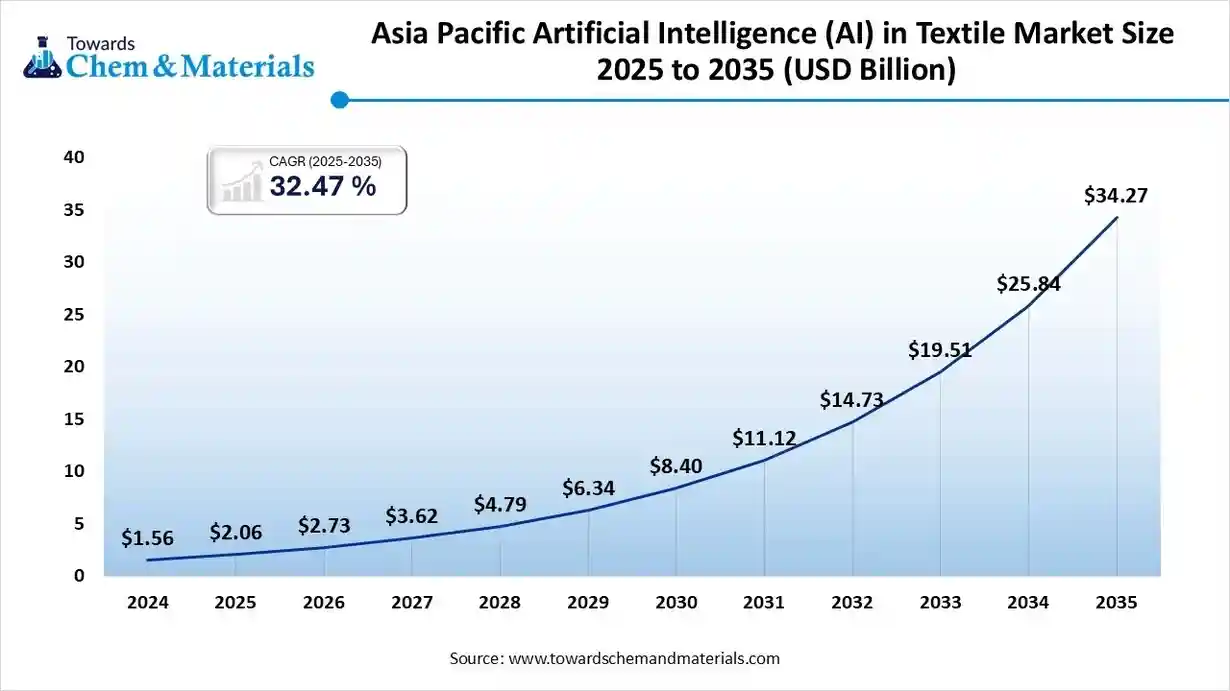
The Asia Pacific artificial intelligence (AI) in textile market size was estimated at USD 2.06 billion in 2025 and is projected to reach USD 34.27 billion by 2035, expanding at a CAGR of 32.47% from 2025 to 2035.
Asia Pacific dominates the market due to its massive textile manufacturing base and rapid adoption of automation across countries like China, India, and Bangladesh. The region benefits from strong government initiatives promoting smart factories and digital transformation, accelerating AI integration in fabric inspection, production optimization, and supply-chain management. Growing investments in advanced technologies, combined with the presence of leading textile exporters, give the Asia Pacific a competitive edge in scaling AI-enabled solutions. The surge in demand for smart textiles, particularly in healthcare and sports sectors, further strengthens the region’s leadership.
China Artificial Intelligence (AI) in Textile Market Trends
China’s market is witnessing strong growth as AI-enabled systems enhance supply-chain visibility and enable a shift from mass production to demand-driven manufacturing. The adoption of generative AI for rapid pattern design and personalized styling is accelerating innovation and reducing development timelines. AI-driven quality control and predictive maintenance tools are significantly lowering defect rates and improving operational efficiency across spinning, weaving, and fabric inspection processes.
North America: The Fastest-Rising Frontier in AI-Enabled Textile Innovation
North America is experiencing the fastest growth in the market due to its strong focus on advanced automation, digital manufacturing, and high-precision textile production. The region’s robust investments in AI research, smart factory technologies, and machine-learning platforms are accelerating the adoption of intelligent textile solutions. Rising demand for high-performance smart textiles in healthcare, defense, and sports is further propelling market expansion. Additionally, the presence of leading AI startups and technology providers supports rapid innovation and seamless integration of AI across textile value chains.
U.S. Artificial Intelligence (AI) in Textile Market Trends
In the U.S., AI adoption in the textile industry is accelerating through predictive maintenance, where smart algorithms monitor machinery in real time to minimize downtime and cut repair costs. There’s strong growth in AI-powered quality control, using computer vision to detect fabric defects much more accurately than manual inspection. Smart, data-driven demand forecasting and inventory management are helping American textile firms optimize supply chains and reduce overproduction.
Europe Artificial Intelligence (AI) in Textile Market Trends
Europe is growing at a notable rate in the artificial intelligence (AI) in textile market. Ongoing textile innovations, such as advanced materials, automation, and smart fabrics, are driving market growth. The strong focus on eco-friendly textile production and the rise in textile customization require AI. The growing demand for smart textiles in industries like construction, healthcare, and automotive drives the overall market growth.
From Looms to Algorithms: Germany’s Role in AI-Driven Fabric Manufacturing
Germany contributes to the growth of the artificial intelligence (AI) in textile market. The growing demand for smart textiles across sectors like metalworking, machinery, and electronics is driving demand for AI. The strong focus on sustainability in textiles and the increasing need for automated manufacturing processes require AI. The focus on lowering fabric waste and complex textile manufacturing processes supports the overall market growth.
Germany exported $30.7B of textiles in 2024.
South America Artificial Intelligence (AI) in Textile Market Trends
South America is significantly growing in the artificial intelligence (AI) in textile market. The growing demand for sustainable & smart textiles across industries such as automotive, healthcare, and sports requires AI. The abundance of raw materials and a focus on textile personalization increase demand for AI. The focus on reducing chemical use, water, & energy, and on developing sustainable textiles, requires AI, driving overall market growth.
Brazil Artificial Intelligence (AI) in Textile Market Trends
Brazil is notably growing in the artificial intelligence (AI) in textile market. The strong government support through initiatives like the Taxbase program and the strong presence of textile companies require AI. The focus on automating textile manufacturing and advancing sustainability trends requires AI. The development of intelligent fabrics and the need for personalized products support the overall market growth.
- Brazil exported $6.08B of textiles in 2024
Middle East & Africa Artificial Intelligence (AI) in Textile Market Trends
The Middle East & Africa are growing in the artificial intelligence (AI) in textile market. The strong focus on predicting fashion trends and developing personalized products increases demand for AI. The modern manufacturing technologies and the development of smart textiles require AI. The growing investment in AI infrastructure in countries like the UAE & Saudi Arabia, and increasing consumer demand for modern textiles, drive the overall market growth.
United Arab Emirates Artificial Intelligence (AI) in Textile Market Trends
The United Arab Emirates is growing rapidly in the AI textile market. The strong government support for Industry 4.0 and smart textile manufacturing requires the use of AI. The growing development of smart factories and a well-established textile manufacturing base requires AI. The strong focus on sustainable practices, automation, and supply chain management in AI in textiles supports the overall market growth.
Top Companies in the Artificial Intelligence (AI) in Textile Market & Their Offerings:
- Microsoft Corporation offers cloud solutions for digital transformation, enhancing production visibility and sustainable manufacturing practices.
- IBM Corporation provides AI-driven tools, such as the Watson platform, for improving supply chain efficiency, predicting trends, and optimizing inventory.
- Google LLC offers advanced software solutions and AI-enabled analytics for wearable technology development, fabric innovation, and sustainable design.
- Amazon Web Services (AWS) provides cloud computing, AI, and data analytics solutions that optimize design, manufacturing, and supply chain management for textile companies.
- H&M Group utilizes AI for demand forecasting, personalization, and generative design to align production with consumer needs and reduce waste.
- Nike, Inc. Uses predictive analytics and computer vision (e.g., the Nike Fit feature) for precise inventory management, demand forecasting, and accurate sizing to reduce returns.
- Levi Strauss & Co. employs AI for customer engagement, personalized recommendations and uses AI-generated models for a diverse online presence.
- Stitch Fix Combines machine learning algorithms with human stylists to provide hyper-personalized outfit recommendations, increasing customer retention and order values.
More Insights in Towards Chemical and Materials:
- Technical Textiles Market : The global technical textiles market size is calculated at USD 255.12 billion in 2025 and is predicted to increase from USD 271.83 billion in 2026 and is projected to reach around USD 481.15 billion by 2035. The market is expanding at a CAGR of 6.55% between 2026 and 2035.
- Textile Chemicals Market : The global textile chemicals market size was reached at USD 30.19 billion in 2024 and is expected to be worth around USD 50.84 billion by 2034, growing at a compound annual growth rate (CAGR) of 5.35% over the forecast period 2025 to 2034.
- Textile Market : The global textile market size is estimated at USD 1.39 trillion in 2025 and is projected to reach around USD 1.45 trillion in 2026, further expected to hit approximately USD 2.01 trillion by 2034, growing at a compound annual growth rate (CAGR) of 4.24% over the forecast period from 2025 to 2034.
- Textile Chemicals Market : The global textile chemicals market volume is expected to produce approximately 1.52 million tons in 2025, with a forecasted increase to 2.46 million tons by 2034, growing at a CAGR of 5.49% from 2025 to 2034.
- Bio-Based Textiles Market : The global bio-based textiles market size reached a size of 54.21 billion in 2025, the market is further projected to grow at a CAGR of 8.55% between 2025 and 2034, reaching a size of 113.43 billion by 2034.
- Geotextiles Market : The global geotextiles market size accounted for USD 10.89 billion in 2025 and is predicted to increase from USD 12.01 billion in 2026 to approximately USD 28.90 billion by 2035, growing at a CAGR of 10.25% from 2025 to 2035.
- Europe Textile Market : The Europe textile market size was reached at USD 260.85 Billion in 2024 and is expected to be worth around USD 410.94 billion by 2034, growing at a compound annual growth rate (CAGR) of 4.65% over the forecast period 2025 to 2034.
- U.S. Textile Market : The U.S. textile market size was approximately USD 196.37 billion in 2025, is expected to reach around USD 204.52 billion in 2026, and further projected to reach about USD 283.15 billion by 2034, with an estimated compound annual growth rate (CAGR) of around 4.15% between 2025 and 2034.
- Asia Pacific Textile Market : The Asia Pacific textile market size is accounted for at USD 698.07 billion in 2025 and predicted to increase from USD 727.32 billion in 2026 to approximately USD 1,010.03 billion by 2034, growing at a CAGR of 4.19% from 2025 to 2034.
AI in Textile Market Top Key Companies:
- Microsoft Corporation
- IBM Corporation
- Google LLC
- Amazon Web Services (AWS)
- SAP SE
- Oracle Corporation
- General Vision Inc.
- Salesforce Inc.
- Adobe Inc.
- Huawei Technologies Co., Ltd.
- Nvidia Corporation
- Siemens AG
Recent Developments
- In November 2025, Taiwan unveiled AI-driven textile technology at ITMAASIACITME 2025 in Singapore, at the “Reshaping Asian Manufacturing: Taiwan’s Smart & Sustainable Textile Solutions” press briefing and media meetup. This event was organized by the Taiwan External Trade Development Council (TAITRA) in partnership with the Taiwan Association of Machinery Industry (TAMI)
- In January 2025, DataBeyond launched an AI tool, the AI Hyperspectral Optical Sorter, to sort blended fabrics in China. The tool sorts textiles containing 30-80% nylon, cotton, polyester, and spandex. The tool supports the large textile and recycling industry
- In October 2025, Fu Hsun Fiber Industries launched a fabric defect detection system, FabGoalie AI, at TITAS 2025. The system consists of features like a GUI and specialized hardware. The system detects various defects like dye stains, broken yarn, creases, oil stains, holes, snagging, and color differences
AI in Textile Market Report Segmentation
This report forecasts revenue growth at global, regional, and country levels and provides an analysis of the latest industry trends in each of the sub-segments from 2019 to 2034. For this study, Towards Chemical and Materials has segmented the global AI in Textile Market
By Technology
- Machine Learning & Deep Learning
- Computer Vision
- Natural Language Processing (NLP)
- Predictive Analytics
- Digital Twins & Simulation
By Material
- Plastics & Polymers (PE, PET, PVC, PP, etc.)
- Glass
By Solution / Offering
- Software Platforms
- Professional Services
- Hardware & Edge Devices
- Managed / Cloud Services
By Application
- Quality Inspection
- Predictive Maintenance
- Process Optimization
- Supply Chain & Demand Forecasting
- Product Design & Development
- Retail & E-Commerce Personalization
By End-Use / Textile Segment
- Apparel & Fashion Manufacturing
- Technical & Industrial Textiles
- Home Textiles
- Nonwoven & Hygiene Products
- Yarn & Fabric Production
By Regional
- North America
- Europe
- Asia Pacific
- Latin America
- Middle East & Africa
Immediate Delivery Available | Buy This Premium Research Report@ https://www.towardschemandmaterials.com/checkout/6000
About Us
Towards Chemical and Materials is a leading global consulting firm specializing in providing comprehensive and strategic research solutions across the chemical and materials industries. With a highly skilled and experienced consultant team, we offer a wide range of services designed to empower businesses with valuable insights and actionable recommendations.
Our Trusted Data Partners
Towards chem and Material | Precedence Research | Statifacts | Towards Packaging | Towards Healthcare | Towards Food and Beverages | Towards Automotive | Towards Consumer Goods | Nova One Advisor | Nutraceuticals Func Foods | Onco Quant | Sustainability Quant | Specialty Chemicals Analytics
For Latest Update Follow Us: https://www.linkedin.com/company/towards-chem-and-materials/
USA: +1 804 441 9344
APAC: +61 485 981 310 or +91 87933 22019
Europe: +44 7383 092 044
Email: sales@towardschemandmaterials.com
Web: https://www.towardschemandmaterials.com/


Legal Disclaimer:
EIN Presswire provides this news content "as is" without warranty of any kind. We do not accept any responsibility or liability for the accuracy, content, images, videos, licenses, completeness, legality, or reliability of the information contained in this article. If you have any complaints or copyright issues related to this article, kindly contact the author above.
